The Autumn Birthday Workout: Use the Outdoors Before It Closes

Quick Answer: Build an autumn birthday workout around age-numbered reps across five movements, done outdoors in the best training weather of the year. Scale by splitting the number into sets rather than lowering it, pick movements that need no equipment, and finish with something you’ll remember rather than something that wrecks you. The point is a marker, not a test.
Birthday workouts have a bad reputation for a reason — most of them are an arbitrary number of burpees performed as self-punishment.
A better version uses the number as structure rather than as suffering, and uses the season, because late September and early October give you conditions you won’t have again until May.

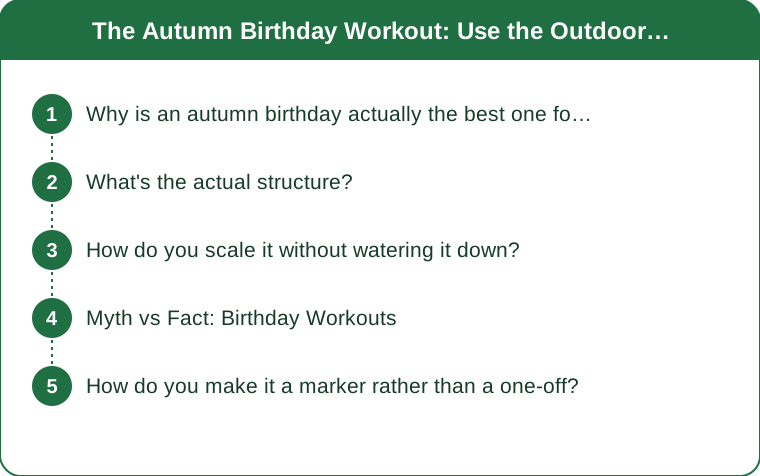
Why is an autumn birthday actually the best one for this?
Because the conditions are genuinely at their annual peak, and this is not sentimentality.
Temperature. Endurance performance is best in cool conditions — roughly 50 to 60°F is where most people perform best, and heat is the single biggest environmental drag on effort. A late-September morning is close to ideal, and the same session that felt brutal in August feels manageable now.
Air quality. In much of the country, late summer ozone has dropped and the worst of the pollen has passed or is passing.
Light. Low-angle golden light in the morning and late afternoon, which sounds cosmetic and matters more than you’d think for whether you actually enjoy being out there.
Ground conditions. Trails are dry, before the wet months turn them to mud, and before the ice.
It’s the last window. In six weeks the outdoor version of this session is much harder to arrange. Marking a birthday with something you can only do now gives it a specificity that a gym session in January doesn’t have.
What’s the actual structure?
Five movements, age-numbered reps, done as a circuit outdoors. It scales to any age and any fitness level, needs no equipment, and takes 25 to 50 minutes depending on the number.
The five:
- Squats — bodyweight, full range, controlled.
- Push-ups — on the ground, on a bench, or against a wall. All three are the same movement at different loads.
- Step-ups — onto a bench or a low wall, alternating legs. Count total reps.
- Reverse lunges — alternating, count total.
- A carry or a hold — a plank, a farmer’s carry with whatever you brought, or a wall sit. Hold for your age in seconds.
The reps: your age, per movement. Turning 34 means 34 squats, 34 push-ups, 34 step-ups, 34 lunges, and a 34-second hold.
Between movements: walk for 60 to 90 seconds. Outdoors, that means walking somewhere pleasant, which is most of the point.
The finisher: a walk or an easy jog of one minute per decade — three minutes at 30, six at 60. Easy pace. This is the part where you actually notice the morning.

How do you scale it without watering it down?
By changing the shape of the number, never the number itself. The number is the meaningful part.
If it’s too much: split each movement into sets. 60 squats becomes 4 sets of 15 across the session, or 6 sets of 10. Same total, entirely different demand. You can spread the whole thing across a morning walk, doing one set every few minutes.
If a movement doesn’t work for you: substitute at the same rep count. Squats become sit-to-stands from a bench. Push-ups become wall push-ups or incline push-ups on a picnic table. Lunges become step-ups or split squats holding a rail. No movement on this list is essential — the structure is.
If it’s too easy: add load rather than reps. A weighted vest, a pack, or a slower tempo — three seconds down on every rep turns an easy set into a hard one without adding a single repetition.
If you’re well past 60: the number gets large and that’s fine, because splitting into sets handles it. A 70-year-old doing 70 sit-to-stands in 7 sets of 10 across an hour outdoors is doing an excellent session. The alternative — reducing the number — loses the thing that made it a birthday workout.
Timing: do it on the day if you can, in the morning. The morning-of version has a quality the rescheduled version doesn’t.
Myth vs Fact: Birthday Workouts
Myth: It should be the hardest workout of your year. Fact: A session that leaves you unable to train for four days isn’t a marker, it’s a setback. The best birthday workouts are memorable and repeatable — you want to be able to do it again next year, and the year after.
Myth: Burpees, because tradition. Fact: Burpees at high volume are one of the most technically demanding movements to keep safe when fatigued, and they’re the reason a lot of birthday workouts end badly. There’s nothing sacred about them.
Myth: You have to do it all at once. Fact: Spreading the reps across a morning is a legitimate and often better version, particularly at higher numbers. Total work done is what matters.
Myth: It needs to be alone, as a personal challenge. Fact: Doing it with people is measurably better for whether you do it at all, and it turns it into something social rather than something grim. Bring someone; they do their own number.
Myth: If you’re not currently training, you should skip it. Fact: This is exactly backwards, and the third myth is where it connects — if you’re not training, split the reps across a whole day of walking outdoors. A session you can complete is worth infinitely more than one you skip because it looked intimidating.
If you have current injuries or a medical condition, adjust with a professional rather than pushing through. This is general information, not medical advice.
How do you make it a marker rather than a one-off?
The value of a birthday workout is the comparison over years, and that requires two minutes of admin.
Write down what you did. Date, movements, sets and reps, how long it took, how it felt. A note in your phone is enough. Next year’s version is only meaningful if this year’s is recorded.
Take one photo. Not for anyone else. The same spot every year is a better record of a decade than almost anything else you could keep.
Pick a location you can return to. A specific park, a specific bench, a specific trailhead. The place becomes part of the tradition and it removes the annual decision about where.
Keep the structure fixed and let the numbers move. Same five movements, every year. What changes is the rep count, which goes up by one, and how you feel doing it, which is the actual data.
Note the weather and the light. Sounds precious; it’s the thing you’ll actually remember reading back.
And one argument for starting this year specifically, whatever your age: the conditions in the next few weeks are the best of the annual cycle, and a tradition that starts in good conditions is one you’ll keep. Starting it in February, in the rain, is how a tradition becomes a single entry in a notes app.
TL;DR:
- Late September is the best outdoor training weather of the year — cool, dry, low pollen, good light.
- Five movements at your age in reps: squats, push-ups, step-ups, reverse lunges, and a hold in seconds.
- Scale by splitting into sets, never by lowering the number. Substitute movements freely at the same count.
- Skip the burpees. A session you can repeat next year beats one that costs you four days.
- Write it down and photograph the same spot. The comparison over years is the entire value.
Do it on the day, in the morning, outdoors, with someone. Start this year while the conditions make it easy.
Keep Reading
This article is for general informational and styling purposes only. Fit, sizing, and product availability may vary.