Better Birthday Fitness Goals Than a Number on the Scale

Quick Answer: The best birthday fitness goals are performance-based, specific, and achievable within a year with two to four sessions a week - a first unassisted pull-up, a 5K without walking, a bodyweight deadlift, 20 consecutive push-ups, a specific hike, or holding a handstand against a wall for 60 seconds. Performance goals work where weight goals fail because progress is visible weekly and success does not depend on factors outside your control.
There’s a particular flavour of disappointment that comes with a birthday goal built around a number on a scale. You either hit it and find it didn’t feel like anything, or you don’t hit it and the whole year reads as failure - even if you got demonstrably fitter, stronger, and healthier along the way.
Performance goals don’t have this failure mode, and they’re more fun.

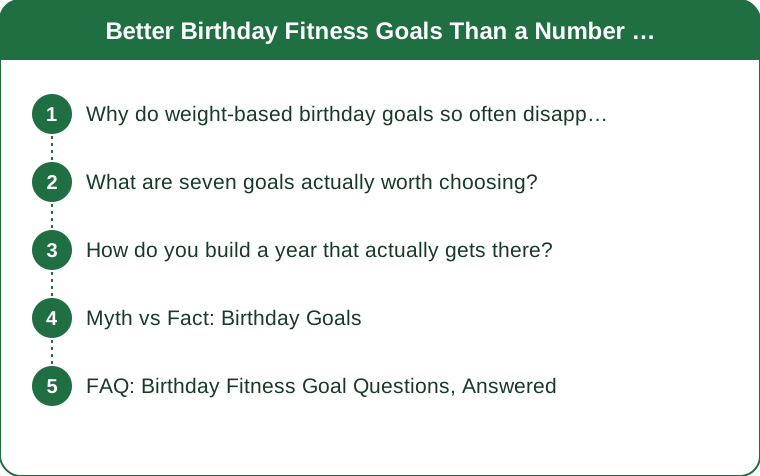
Why do weight-based birthday goals so often disappoint?
Three structural reasons, and none of them are about willpower.
Weight is an outcome, not a behaviour. You can’t directly do ‘lose 15 pounds’ - you can only do things you hope will produce it. And weight responds to sleep, stress, hormones, medication, sodium, and the menstrual cycle, all of which move the number without any relationship to what you actually did. A goal you can’t directly control is a goal that will sometimes punish you for doing everything right.
The feedback loop is too slow and too noisy. Daily weight fluctuates by several pounds for reasons that have nothing to do with fat. Meaningful change takes weeks to emerge from that noise. Meanwhile, a performance goal gives you clean weekly feedback: last week five push-ups, this week six.
Hitting it often feels flat. This is the part nobody warns you about. Arriving at a target weight frequently produces a strange anticlimax, partly because the number was standing in for something else - feeling capable, feeling at home in your body - that the number doesn’t actually deliver.
Compare that to a first pull-up. You either did it or you didn’t, nobody can take it away, and the moment it happens is genuinely thrilling. That difference isn’t psychological trickery - it’s the difference between a goal that measures a behaviour and one that measures a byproduct.
What are seven goals actually worth choosing?
Each is achievable in a year from a realistic starting point, with a rough timeline.
1. A first unassisted pull-up. The classic, and genuinely hard for most women, which is exactly why it’s satisfying. Timeline: 6 to 12 months with twice-weekly dedicated work. Route: assisted pull-ups, negatives, ring rows, hangs.
2. Run 5K without walking. Timeline: 9 to 12 weeks from nothing, using a structured walk-run program. Genuinely life-changing for a lot of people and by far the fastest win on this list.
3. Deadlift your own bodyweight. Timeline: 6 to 12 months for most beginners training twice a week. Excellent goal because it scales to you rather than to an arbitrary number.
4. Twenty consecutive push-ups from the floor. Timeline: 4 to 8 months. Requires no equipment and no gym, which removes most of the usual excuses.
5. A specific hike or walk. A named trail, a named hill, a coastal path. Timeline varies, and the specificity is the value - a date and a location are far more motivating than ‘get fitter’.
6. A 60-second wall handstand hold, or a solid crow pose. Timeline: 3 to 9 months. Good for anyone who finds strength goals dull, and it develops shoulder and wrist resilience that transfers everywhere.
7. Touch your toes, properly, with straight legs. Unglamorous and enormously satisfying for people who’ve never been able to. Timeline: 3 to 6 months with daily short sessions.
How to choose: pick the one you’d be slightly embarrassed to admit you want. That’s usually the one that means something.

How do you build a year that actually gets there?
The goal is the destination. The structure is what gets you there, and most people skip it.
Work backwards into quarterly checkpoints. For a pull-up goal starting from zero:
- Month 3: 30-second dead hang, 3 sets of 8 ring rows at 45 degrees
- Month 6: 3 sets of 5 band-assisted pull-ups with a medium band, 10-second negatives
- Month 9: light band assistance only, negatives of 15 seconds
- Month 12: unassisted
Checkpoints are what make a twelve-month goal survivable. A year is too long to hold motivation against a distant endpoint, and quarterly markers turn it into four short projects.
Two to three focused sessions a week is enough. More is usually counterproductive - these adaptations need recovery, and the failure mode for motivated people is doing too much in month one and stopping in month two.
Track the input, not just the output. Log sessions completed, not just performance. A month where you trained eight times and got no stronger is still a successful month - strength gains arrive in steps, not slopes, and the training is the part you control.
Build in a deload. Every fourth week, cut the volume in half. This feels like slacking and is actually where a good deal of adaptation happens.
Expect a plateau around month four to six. It’s normal, it’s not a sign the plan failed, and it usually breaks within a few weeks of continued consistent work.
Myth vs Fact: Birthday Goals
Myth: A big scary goal is more motivating. Fact: Goals slightly beyond current ability motivate best. Goals wildly beyond it produce avoidance, because the gap is too large to see progress against. A first pull-up is a good goal; ten pull-ups from a starting point of zero is a good way to quit in March.
Myth: You should start on your birthday. Fact: Start whenever you decide, which is ideally the day you decide. Waiting for a date is a well-documented way of losing the motivation that made you decide in the first place.
Myth: Age makes these goals unrealistic. Fact: Strength and skill goals are achievable at essentially any adult age - people learn to deadlift and do pull-ups in their sixties and seventies routinely. Timelines lengthen somewhat and recovery needs more attention, but the direction of travel is the same.
Myth: You need a gym. Fact: Push-ups, running, hiking, flexibility, and handstands need nothing. Pull-ups need a bar, which is a doorway fitting. Only the deadlift goal genuinely requires a gym.
Myth: If you miss the deadline, you failed. Fact: A goal with a deadline is a planning tool, not a contract. Arriving at your first pull-up fourteen months in rather than twelve is not a failed year - it’s a pull-up you didn’t have before, achieved through a year of training.
FAQ: Birthday Fitness Goal Questions, Answered
Can I have more than one goal?
One primary goal and one secondary works well. Three or more compete for the same recovery capacity and training time, and the usual result is slow progress on everything. If you want two, pick ones that complement - a strength goal and a flexibility goal, rather than two strength goals.
What if I genuinely do want to change my body composition?
That’s a completely legitimate goal, and the practical answer is to pursue it through performance targets anyway. Getting meaningfully stronger while eating adequate protein and sleeping properly changes body composition, and it gives you weekly wins the scale won’t.
How do I stay motivated in month seven?
Motivation isn’t the mechanism - the checkpoint structure is. Also: tell someone, book the event, put the hike in the calendar with a date. External commitment carries you through the flat middle stretch far better than enthusiasm does.
Is it worth hiring a coach for a year-long goal?
For the pull-up and deadlift goals, even a handful of sessions to establish technique pays for itself in avoided plateaus and avoided injury. For running and flexibility goals, a good free structured program is usually plenty.
TL;DR:
- Weight goals fail because weight is an outcome you don’t directly control and the feedback is slow and noisy
- Performance goals give clean weekly progress and a definite, satisfying moment of success
- Seven good ones: first pull-up, 5K unbroken, bodyweight deadlift, 20 push-ups, a named hike, a wall handstand, touching your toes
- Break the year into quarterly checkpoints - a year is too long to hold as a single target
- Two to three focused sessions a week, with a deload every fourth week
- Expect a plateau around months four to six; it’s normal and it breaks
Pick the one you’d be slightly embarrassed to say out loud. That’s the one worth a year.
Keep Reading
This article is for general informational and styling purposes only. Fit, sizing, and product availability may vary.