Your Birthday Landed Mid-Training-Block. Now What?

Quick Answer: Move the deload, do not delete the session. If your birthday falls in a hard week, swap that week’s easy day onto the celebration day and shift the harder work either side. One late night and a big meal will not undo a training block; three weeks of guilt-driven overcompensation will.
The conversation happens every year in some form. The block is going well, the numbers are moving, and then the calendar produces a day involving late food, several drinks, and no realistic chance of a 6am session. Some people cancel the celebration. Some people cancel the week. Both are overreactions to what is, structurally, a one-day scheduling issue.

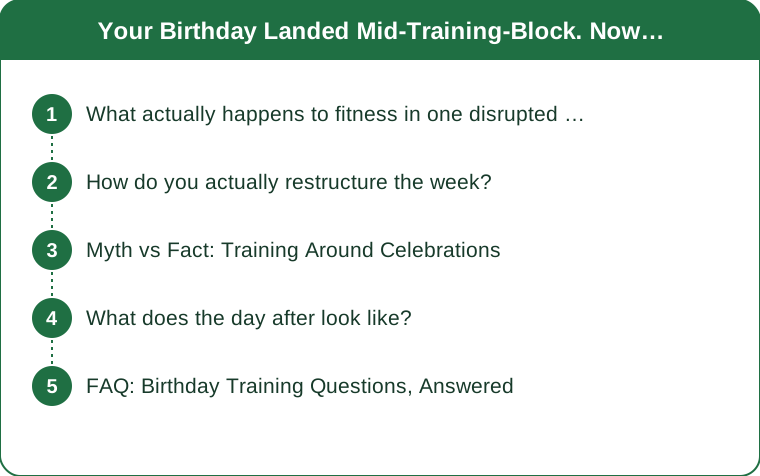
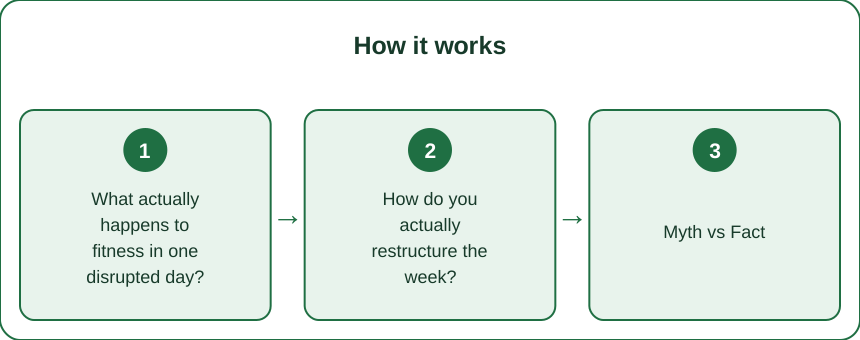
What actually happens to fitness in one disrupted day?
Very little, and understanding why makes the whole thing easier to plan around.
Detraining - the measurable loss of aerobic fitness and strength - takes considerably longer than a day. Meaningful reductions in aerobic capacity typically start showing after roughly one to two weeks of complete inactivity, and strength holds on longer still. A single missed session in a twelve-week block is statistical noise.
What one disrupted day does affect is short-term readiness. Poor sleep and alcohol both reduce next-day performance and recovery quality, which is a real effect on tomorrow, not a real effect on your fitness. Alcohol in particular fragments the second half of the night, blunts overnight recovery, and leaves you dehydrated for a morning session.
So the correct planning question is not how do I protect my fitness. It is what should tomorrow look like, given that today involves cake and a late night. That is a much smaller question with a much easier answer.
How do you actually restructure the week?
Three approaches, in order of how well they usually work:
Option 1: Slide the rest day. (Best for most people.) Every sensible week has at least one easy or off day. Move it onto the birthday. Then shift the sessions around it so you are not doing your hardest work the morning after. If the birthday is Saturday, the week becomes: hard Thursday, easy Friday, off Saturday, easy Sunday, resume Monday.
Option 2: Move the deload week. (Best if the birthday lands in a heavy week.) If your plan has a deload every fourth week and your birthday falls in week three, run the deload a week early. You lose almost nothing - deload timing is flexible by a week in either direction in nearly every programme.
Option 3: Train early, celebrate later. (Best if the day is otherwise free.) Do the session in the morning before anything starts. It removes the decision entirely and the session is usually good, because there is no dread attached to it.
What does not work is doubling up beforehand. Cramming Saturday’s session into Friday alongside Friday’s own work is how people arrive at their birthday exhausted and injured, having protected a number on a spreadsheet at the cost of the actual week.

Myth vs Fact: Training Around Celebrations
Myth: You should earn the cake with a hard session first. Fact: Framing food as something to be paid for is a reliable route to a bad relationship with both. Eat the cake. Train because it is on the plan, not as currency.
Myth: A big meal will set you back. Fact: One day of higher intake is trivially absorbed across a week. Body composition responds to averages over weeks, not to single days.
Myth: You should train the next morning to flush it out. Fact: There is nothing to flush. A gentle walk is genuinely helpful for how you feel; a punishing session on four hours of sleep is just a worse session with a higher injury risk.
Myth: Missing a session means restarting the plan. Fact: Plans are directional, not fragile. Pick up where you left off.
Myth: Alcohol wipes out a week of training. Fact: It measurably affects the next 24 to 48 hours - sleep quality, hydration, and next-day power output. It does not reach backward and undo work already done.
What does the day after look like?
Assume less sleep than usual and plan accordingly. The session that works the day after a late night is almost always aerobic, moderate, and long enough to feel like something without requiring precision.
Good the day after: an easy 30 to 60 minute walk, an easy spin, mobility work, a light technical session where the emphasis is on movement quality rather than load.
Bad the day after: heavy singles, sprint work, anything requiring sharp reaction or balance, and any session where a technical failure means a dropped bar. Coordination and reaction time are measurably worse on poor sleep, which is a safety issue rather than a performance one.
Hydrate properly before you attempt anything - a large glass of water on waking and another before you start. Eat a normal breakfast rather than a corrective one.
And then just resume. The block is not behind - it is exactly where it was, plus one birthday. If you needed permission for that, consider it granted.
FAQ: Birthday Training Questions, Answered
Should I skip my workout on my birthday?
If the day is full, yes - move the rest day onto it. If the day is otherwise free, an early session usually improves the day rather than costing you anything.
How long does it take to lose fitness?
Measurable aerobic decline generally begins after one to two weeks of complete rest, and strength holds longer. One or two disrupted days do not register.
Can I still train after drinking?
A gentle walk or easy aerobic session is fine and often helps. Skip heavy lifting, sprinting, and anything technical - reaction time and coordination are reduced, which makes it a safety question rather than a toughness one. This is general information, not medical advice.
TL;DR:
- Move the rest day or the deload onto the birthday; do not delete sessions or double up beforehand.
- One disrupted day affects tomorrow’s readiness, not your fitness.
- The day after should be easy, aerobic, and non-technical.
- Resume the plan where you left off - it is not behind, it is just one day older.
The people who stay consistent for years are not the ones who never miss a day. They are the ones who have a boring, pre-decided plan for the days they were always going to miss.
Keep Reading
This article is for general informational and styling purposes only. Fit, sizing, and product availability may vary.