The Birthday Workout for People Who Hate Being Sung To

Quick Answer: A birthday workout doesn’t have to be a group event. The version that works for people who dislike attention is a solo effort that’s meaningfully harder or longer than your normal session, done somewhere you don’t usually go, with no announcement to anyone. The marker is the effort and the location, not the audience - and it tends to be more memorable than the class where a stranger led a round of applause.
Somebody in the group chat has already suggested a themed class with matching leggings. This is the alternative.

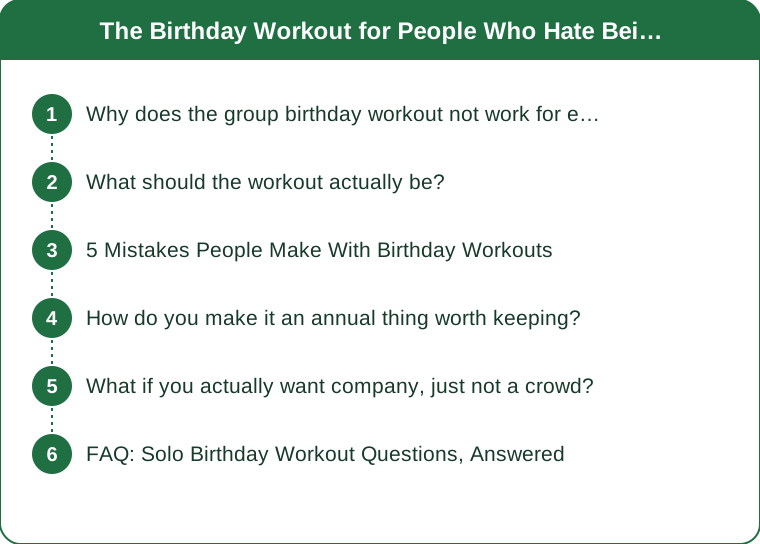
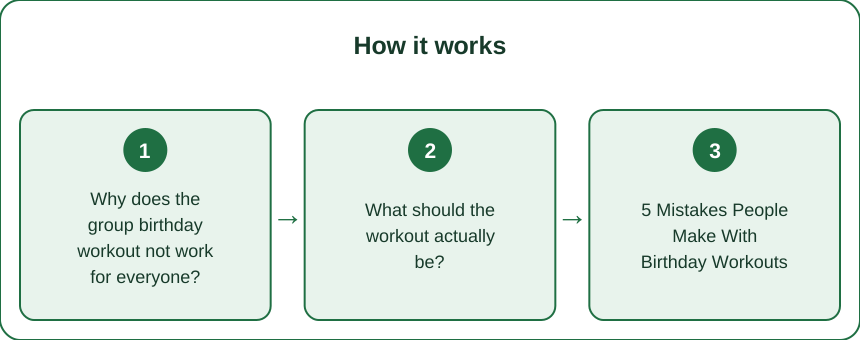
Why does the group birthday workout not work for everyone?
Because it optimises for the wrong thing - visibility rather than the experience.
The standard version has a specific shape: a booked class, a group, a coordinated outfit, a photo, and at some point an instructor announcing your birthday to the room. For a lot of people that’s genuinely fun. For a lot of others it converts a day they were looking forward to into a social obligation with a workout attached.
The alternative isn’t doing nothing. A birthday is a useful annual marker precisely because it recurs - it’s a natural checkpoint for noticing what’s changed in a year. That function doesn’t require anyone else to be present.
What makes a solo birthday workout feel like an occasion rather than a Tuesday:
- A different location. Novelty does most of the work. The same run on a new trail is a different experience.
- A different distance or effort. Something meaningfully beyond your usual - not a maximal test, just clearly more.
- No phone, or a phone in airplane mode. The absence of notifications is a large part of what makes the hour feel separate.
- A deliberate start and finish. Coffee before, a proper meal after, a route with an actual endpoint.
Nothing on that list requires telling a single person.
What should the workout actually be?
Three formats, choose by what you already do.
Format 1 - The distance marker. Run, walk, hike, cycle, or swim a distance that connects to the number. Turning 34: a 3.4-mile run, or 34 minutes of continuous effort, or a 34-length swim. The number gives it structure without ceremony, and it scales naturally as the years go on.
Format 2 - The new-location session. Take your normal workout somewhere you’ve never done it. A trail you’ve driven past, a park two towns over, an outdoor pool, a stretch of coast, a hill you’ve been curious about. Novelty of place is the most reliable way to make an ordinary effort memorable - and unlike a distance challenge, it costs you nothing in recovery.
Format 3 - The thing you’ve been putting off. The class you’ve been curious about but haven’t booked. The heavier lift you keep deferring. The open-water swim. The first cold-weather run of the season. Birthdays are a decent excuse to do the thing that’s been on the maybe list for eight months, and doing it alone removes the pressure of being bad at it in front of people.
A rule that applies to all three: don’t schedule a genuinely hard session for the actual day if you have plans that evening. A 90-minute effort followed by dinner with family is a recipe for falling asleep at the table. Do the workout the morning of, or shift it to a nearby day.
5 Mistakes People Make With Birthday Workouts
Mistake 1: Turning it into a fitness test. A maximal effort on an arbitrary date tells you almost nothing, because your readiness on any given day swings with sleep, stress, and the week’s training. If you want an annual benchmark, do it on a well-rested day of your choosing and let the birthday be about enjoyment.
Mistake 2: Doing your age in something. Burpees, push-ups, or minutes on a rower scaled to your age is a fun idea that ages badly - literally. It gets harder every year at the exact rate your recovery capacity is going the other way, and it’s a common route to a strain.
Mistake 3: Combining it with a restrictive eating day. The ‘earn the cake’ framing turns a good day into a transaction. It also doesn’t work physiologically in any meaningful way, and it makes both the workout and the meal worse.
Mistake 4: Scheduling it around other people’s availability. The whole point of a solo version is that it happens when you want it. Once you’re coordinating times, you’ve reinvented the group workout with extra steps.
Mistake 5: Documenting it. If you’re stopping to film, you’re not having the experience - you’re producing content about it. The single best upgrade to a solo birthday workout is leaving the phone in the car.

How do you make it an annual thing worth keeping?
The value compounds if it’s repeatable, so build it to be repeated.
Pick a format you can do at any fitness level. A distance you can walk if you can’t run. A route that works in any weather. Something that doesn’t depend on being in good shape that particular year, because some years you won’t be.
Return to the same place, or deliberately never do. Both work, and they do different things. The same route every year becomes a measuring stick - you notice how the hill feels, what’s changed in the landscape, how you feel doing it. A new place every year becomes a collection, and a reason to look at maps in August.
Write down three lines afterwards. Where you went, how it felt, one thing about the year. Three lines takes ninety seconds and becomes genuinely interesting to read at year five. Keep it in the same note so the entries stack up.
Keep it small enough to survive a bad year. The version that requires a free morning, good weather, and decent fitness will get skipped the year you have none of those. The version that’s ‘walk somewhere new for an hour’ survives everything, including a newborn, a house move, and a rough January.
And consider moving it off the actual date. Birthday weekends are often busy with other people’s plans. Doing this on the nearest quiet morning - or on the first day of the month - keeps it protected.
What if you actually want company, just not a crowd?
The binary of ‘solo’ versus ‘group class’ skips the middle, which is where most people land.
One person who doesn’t make it a thing. A walk or run with a single friend who knows it’s your birthday and won’t mention it beyond the first minute is a completely different experience from a class of twelve. The number that changes the dynamic is usually three or more, not two.
Parallel rather than together. Going to the pool, the climbing wall, or the gym with someone and doing your own thing in the same space gives you company without conversation or coordination.
A public event where you’re anonymous. A parkrun, an organised hike, a drop-in class in a town you don’t live in. There are other people, none of them know it’s your birthday, and nobody is going to sing.
And a script for declining the group version, since that’s usually the actual problem: ‘I’m doing something quiet in the morning - can we do dinner instead?’ Offering an alternative time rather than declining outright is what makes this land well, and it gives the people who wanted to celebrate with you something to say yes to.
The underlying point is that the day is yours to spend, and ‘I’d rather do this on my own’ is a complete answer that doesn’t require justification. This is general information about how people organise their time, not a prescription - some years the group class is exactly right.
FAQ: Solo Birthday Workout Questions, Answered
Isn’t doing it alone a bit sad?
Only if you’d rather be with people. Choosing solitude deliberately is a different thing from ending up alone, and plenty of people find a quiet hour outdoors the best part of the day.
Should I do something harder than usual or take it easy?
Moderately harder, at a distance or duration that’s clearly beyond routine but well short of a maximal effort. Hard enough to feel like an occasion, easy enough that you’re good company at dinner.
What if the weather’s terrible on the day?
Move it. The date has no physiological significance, and the nearest good morning is a better version of the same thing.
Does it count if I do it a week early or late?
Entirely. The marker is the annual repetition, not the calendar precision - and the nearest quiet morning is usually a better experience anyway.
TL;DR:
- The marker is the effort and the location, not the audience
- Pick a distance tied to the number, a new place, or the thing you’ve been deferring
- Skip age-based rep challenges - they scale exactly the wrong way over time
- Write three lines afterwards; at year five it’s the best part
- ‘Something quiet in the morning, dinner instead’ is a complete answer
Nobody has to sing. Go somewhere new and come back for cake.
Keep Reading
This article is for general informational and styling purposes only. Fit, sizing, and product availability may vary.