The Birthday Workout When You Are Nowhere Near Fit

Quick Answer: Scale the age-in-reps birthday workout by splitting your age across the whole day rather than one session, by choosing movements you can already do well, and by picking a rep total you can finish rather than one you can barely start. Forty reps of a movement you can do beats forty reps of one you cannot. The point is to finish, not to be destroyed.
The standard birthday workout is designed by fit people for fit people. If you are starting from a long way back, doing it as written is a good way to be sore for four days and never do it again.

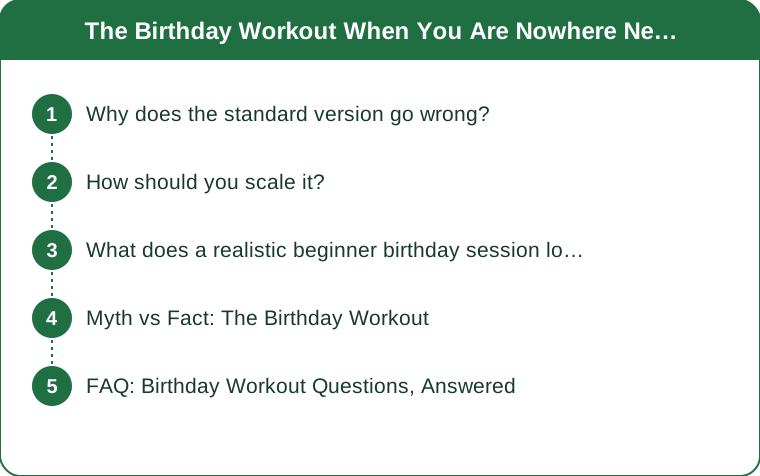
Why does the standard version go wrong?
Because the reps scale with age while your training history does not.
The classic format - do your age in burpees, or in reps of five movements - has a structural problem. A fit 25-year-old does 25 reps. An untrained 45-year-old does 45. The person with the least conditioning is assigned the most work, and the movement is usually a burpee, which is the least beginner-friendly exercise in common use.
Three things go wrong specifically:
- Form collapses in the back third. The last fifteen reps are done badly, which is where the soreness and the injuries come from.
- The session is unfamiliar and maximal at the same time. Novelty plus maximum effort is the classic recipe for excessive soreness.
- It becomes a one-off. A workout that leaves you unable to walk downstairs on Tuesday does not lead to a Wednesday session.
The fix is not to skip it. A birthday workout is a genuinely good ritual - a fixed annual marker, no equipment needed, and a nice way to note the date. It just needs a version that respects where you are actually starting from.
How should you scale it?
Four levers, and you can pull any combination of them.
Lever 1: Split it across the day. Your age in reps, but in sets of five spread from morning to evening. Forty-two reps becomes eight or nine small efforts. This is the most underrated version and by far the most finishable - and it keeps you moving all day, which is more useful than one hard block.
Lever 2: Change the movement, not the number. Keep your age as the rep count and pick something you can do with good form throughout:
- Instead of burpees: sit-to-stand from a chair
- Instead of press-ups: incline press-ups against a counter
- Instead of pull-ups: band rows or a bent-over row with anything heavy
- Instead of jump squats: bodyweight squats to a box
Lever 3: Reduce the number honestly. Half your age is a perfectly respectable target. Finishing 21 with good form is a better session than abandoning 42 at rep 19.
Lever 4: Use time instead of reps. Your age in seconds of a plank, a wall sit, or a march, split into chunks. Time-based work self-regulates in a way rep-based work does not.
Rest generously. 60 to 90 seconds between sets. Nobody is timing you.

What does a realistic beginner birthday session look like?
Here is a version that takes about 25 minutes and leaves you able to walk normally the next day.
Warm-up - 5 minutes:
- Marching on the spot, 2 minutes
- Arm circles and shoulder rolls, 1 minute
- Bodyweight squats to a chair, 10 slow reps
- Standing hip circles, 10 each way
Main block - your age split across five movements. Divide your age by five and round. For 45, that is 9 reps of each, done as a circuit, three times through with 90 seconds rest between rounds:
- Sit-to-stand from a chair, 9
- Incline press-up against a kitchen counter, 9
- Band row or bent-over row with a heavy bag, 9
- Glute bridge on the floor, 9
- March in place, 9 each side, knees high
That is 135 total reps across the session, at an intensity you can sustain, using five movements that cover the whole body.
Finish - 5 minutes: Walk, then a calf stretch, a hip flexor stretch, and a chest doorway stretch, 30 seconds each side.
Two rules for the day: stop any set that gets ugly, and finish feeling like you could have done one more round. The version of this that becomes an annual tradition is the one you enjoy, not the one that maximises soreness.
If you have any cardiac condition, joint problem, or you are returning from an injury or a long inactive period, check with a professional before starting something new. This is general information, not medical advice.
Myth vs Fact: The Birthday Workout
Myth: It has to be hard enough to hurt to count. Fact: The tradition’s value is that it happens every year on a fixed date. Repeatability is the whole benefit, and a session that puts you off for twelve months has negative value.
Myth: Burpees are the standard so you should do burpees. Fact: The burpee is popular because it needs no equipment, not because it is the best movement. It combines a squat, a plank, a press-up, and a jump - four things that each need learning. Substituting is not cheating.
Myth: You should do it alone so nobody sees you struggle. Fact: Doing it with someone doubles the completion rate and makes it a social event rather than a test. Everyone doing their own age means everyone does a different number, which conveniently removes the comparison.
Myth: If you cannot do the whole thing you have failed. Fact: Partial completion on the day, finished the next morning, is still the ritual. The date is the marker, not the unbroken block.
Myth: More reps every year shows you are getting fitter. Fact: The number goes up whether you train or not - that is just the calendar. If you want a fitness measure, record how long the session took and how you felt afterward. Those numbers moving in the right direction across years is the genuinely interesting data, and the one that surprises people most.
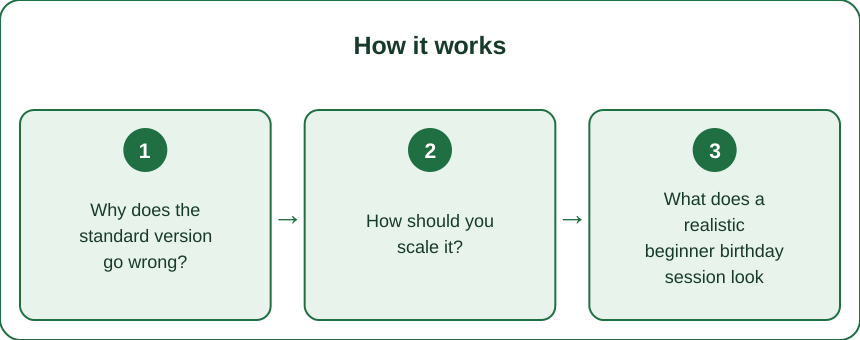
FAQ: Birthday Workout Questions, Answered
What if my age is more reps than I can imagine doing?
Split across five movements and three rounds, spread across the whole day, or halve the number. Any of these keeps the ritual intact.
Should I do it on the day itself?
Whenever suits. A lot of people do it the weekend closest to the date, which is more practical than a Tuesday morning before work.
How sore should I expect to be?
Mildly, for a day or two, especially if this is new. Severe soreness lasting several days means the session was too much for your current base - scale down next year rather than concluding you are unfit.
Can I count a walk or a swim instead?
Yes. Your age in minutes of walking, or laps, or flights of stairs is a perfectly good version and a much better fit for some people.
What is a good way to make it stick as a tradition?
Write down what you did and how it felt, somewhere you will find it next year. The note is what turns one workout into a twenty-year record.
TL;DR:
- The standard age-in-reps format gives the most work to the least trained person
- Split the reps across the day, or across five movements and three rounds
- Swap any movement you cannot do well for one you can - substitution is not cheating
- Finish feeling like you had one more round in you
- Record the time and how it felt; that is the number that actually tracks fitness across years
The birthday workout is one of the better fitness traditions going, precisely because it is annual, free, and needs no equipment. Just build a version you will still be doing at seventy, which means building one you can finish this year.
Keep Reading
This article is for general informational and styling purposes only. Fit, sizing, and product availability may vary.