The Birthday Workout That Scales to Any Age (And Actually Finishes)

Quick Answer: The classic your-age-in-reps workout scales badly - it is trivial at 25 and brutal at 55, and it always ends with too many reps of the hardest exercise. Fix it by splitting your age across multiple exercises, putting the hardest movement first while you are fresh, and capping any single exercise at 25 reps. A well-built version takes 20-30 minutes and leaves you able to enjoy the day.
The point of a birthday workout is to mark the day, not to be unable to sit down at dinner. Those two goals are more compatible than most versions of this allow.

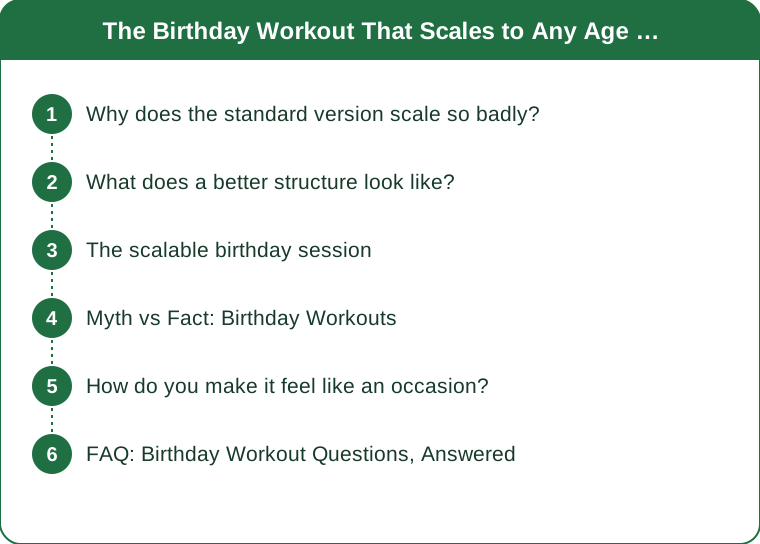
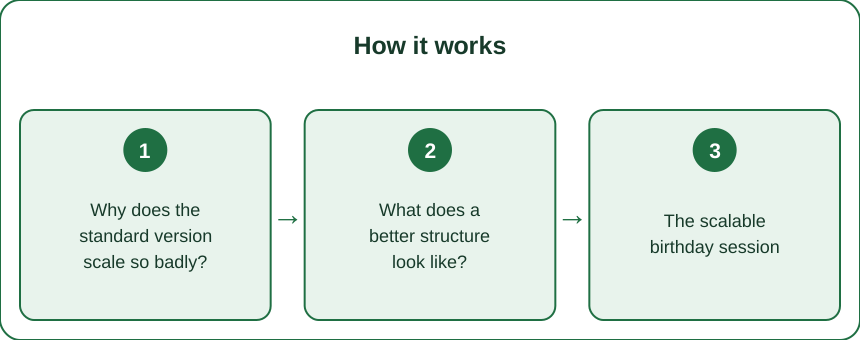
Why does the standard version scale so badly?
Because difficulty does not increase linearly with reps, and age is a linear number.
The classic format: do your age in reps of five or six exercises. It sounds elegant. In practice:
- At 25, five exercises of 25 reps is a solid but ordinary session
- At 45, the same format is 225 total reps and the last two exercises become a grind
- At 60, it is 300 reps and the workout has stopped being a celebration
The deeper problem: fatigue is not linear. Reps 1-15 of an exercise are steady. Reps 30-50 are disproportionately harder because form degrades, breathing falls apart, and the movement quality drops off a cliff. A set of 50 push-ups is not twice as hard as 25 - it is more like four times.
And the exercise choice compounds it. Burpees are the traditional finisher and they are the worst possible choice for high reps, because they involve a hinge, a plank, and a jump when you are most fatigued. That combination is where people get hurt in these workouts.
One more issue nobody mentions: the workout gets harder every year by design, at exactly the age when recovery is getting slower. That is backwards. A good birthday tradition should be repeatable at 60, not something you quietly abandon at 45.
What does a better structure look like?
Split the number, cap the reps, and front-load the hard work.
Three rules:
1. Your age is the total, not the per-exercise count. If you are 42, the session is 42 reps of each of a few movements, or 42 reps split across a circuit you repeat - not 42 of everything.
2. Cap any single exercise at 25 reps. Above that, form degrades and the extra reps add fatigue without adding stimulus. If your age is above 25, do multiple rounds of a lower number instead.
3. Hardest movement first. Whatever is most technically demanding goes at the start when you are fresh. The traditional structure does the reverse and that is why the last block is where things go wrong.
Optional fourth rule: include one thing you could not have done ten years ago. A slightly heavier weight, a longer hold, a movement you have been working on. This is what makes it a birthday workout rather than just a workout, and it points forward instead of back.
Time target: 20-30 minutes. Long enough to feel like an event, short enough that it happens before the rest of the day gets in the way.
The scalable birthday session
Written to work at 25 and at 65 with the same structure. Take your age, divide by 5, round up - that is your reps per exercise per round. Do 5 rounds.
So at 40: 8 reps of each, 5 rounds. At 55: 11 reps of each, 5 rounds. At 30: 6 reps of each, 5 rounds.
The five exercises, in this order:
- Goblet squat - the most demanding, done first. Hold a dumbbell, kettlebell, or a heavy bag at your chest
- Push-up - on the floor, on the knees, or hands on a bench. Choose the version where the last rep of round five is still clean
- Bent-over row - dumbbells, a band, or two heavy grocery bags
- Reverse lunge, that many each side
- Dead bug, that many each side. Ends each round with something controlled and core-focused rather than another blast of cardio
Rest 60-90 seconds between rounds. Do not skip this. The rest is what keeps round five looking like round one.
Total time: 20-28 minutes for most people.
Warm up first, properly: 5 minutes of walking or marching, 10 bodyweight squats, 10 arm circles each direction, 5 slow lunges each side. On a birthday there is a strong temptation to skip this and get on with it. Do not - a cold start on a high-rep session is how the day gets memorable for the wrong reason.

Myth vs Fact: Birthday Workouts
Myth: It should be the hardest workout of the year. Fact: A session so hard you cannot walk properly for three days is a poor way to mark a birthday and a poor training decision. Hard and memorable is the target; wrecked is not.
Myth: Burpees are the traditional birthday exercise. Fact: They are traditional and they are the worst choice for high reps, because the combination of hinge, plank, and jump under heavy fatigue is where technique fails. Use them for one round if you love them, not for all of them.
Myth: If you cannot finish, you failed. Fact: An unfinished workout is a scaling problem, not a character problem. Cut a round and finish strong - that is the version you will repeat next year.
Myth: You should do it first thing in the morning. Fact: Do it whenever you will actually do it. Late morning after breakfast is easier on most people than fasted at 6am, and the compliance matters more than the timing.
Myth: The older you get, the more you should scale down. Fact: You should scale the format, not the ambition. A 60-year-old doing five well-loaded rounds with good form is doing a better workout than a 30-year-old grinding out 300 sloppy reps.
How do you make it feel like an occasion?
Four things, none of which involve making it harder.
Do it somewhere different. A park, a beach, the yard, a trail. The location does more for the sense of occasion than any exercise choice, and it costs nothing.
Bring someone. A partner, a friend, a family member doing their own scaled version. Group versions of this scale beautifully - everyone does their own age, so everyone finishes at roughly the same time regardless of the age gap, which is a genuinely elegant feature of the format.
Record it. Not for social media necessarily - write down the weight, the rounds, and how it felt, somewhere you will find it next year. The year-over-year comparison is the actual value of a birthday tradition, and it only exists if you write it down.
Add one benchmark. A single maximum effort at the end: how long you can hold a plank, how far you can walk in ten minutes, how many push-ups in one set. One number, tracked annually. It turns the workout into a measurement rather than just an event.
And then stop. Shower, eat something good, get on with the day. The most common mistake in birthday workouts is treating them as the start of a new regime and doing something equally ambitious the next day. Take the rest day. The tradition is annual; the training is the other 364 days.
If you have a heart condition, a joint issue, or have not exercised regularly in a while, scale the rounds down and check with a doctor before doing a high-rep session. This is general information, not medical advice.
FAQ: Birthday Workout Questions, Answered
What if my age is over 60?
The divide-by-five structure handles it - at 65 that is 13 reps per exercise for five rounds, which is a well-proportioned session. Reduce to four rounds if 13 reps of squats is genuinely difficult.
Can I do this with no equipment?
Yes. Bodyweight squat, push-up on an incline, band row or towel row, reverse lunge, dead bug. The structure is unchanged.
Should I do it on the actual day?
Whichever day you will do it. The nearest weekend morning is usually more realistic than a Tuesday.
How do I make it harder next year without adding reps?
Add weight, slow the tempo, or reduce rest by 15 seconds. All three are better progressions than more reps, and all three keep the session the same length.
TL;DR:
- Age in reps scales badly because fatigue is not linear - 50 reps is not twice as hard as 25
- Divide your age by five, do that many reps of five exercises, five rounds
- Hardest movement first, cap any exercise at 25 reps, rest 60-90 seconds between rounds
- Skip high-rep burpees; that is where form and safety both fail
- Write down the numbers - the year-over-year comparison is the real point
Build it so you can still do it at 65 and it becomes a tradition. Build it to be the hardest thing you have ever done and it becomes something you quietly stop doing at 45.
Keep Reading
This article is for general informational and styling purposes only. Fit, sizing, and product availability may vary.