The Turning-50 Workout: What Actually Matters in the Next Decade

Quick Answer: The highest-value training in your fifties is heavy resistance work two to three times weekly, plus impact or loaded movement for bone density and dedicated single-leg balance work. Cardio matters and most people already do enough of it. The specific target worth having is muscle and strength maintenance, because the rate of loss accelerates from here and it is the single biggest predictor of independence later.
Milestone birthdays generate challenges - fifty burpees, fifty miles, a 50k. They are fine, and they are not the question worth asking at fifty. The better question is what training now changes how the next twenty-five years go.

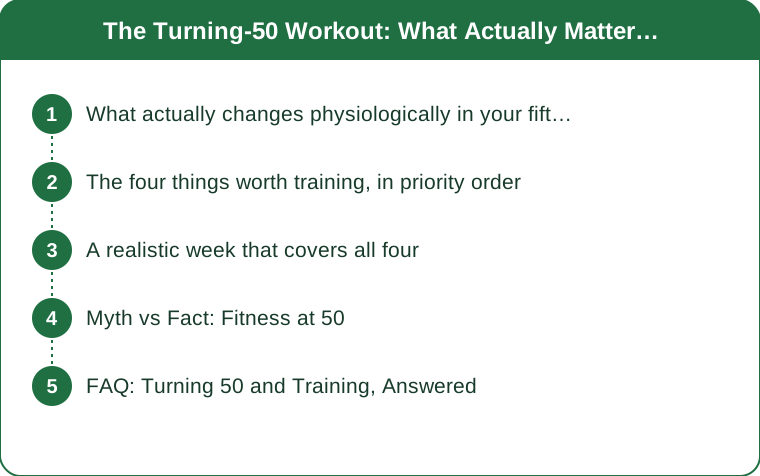
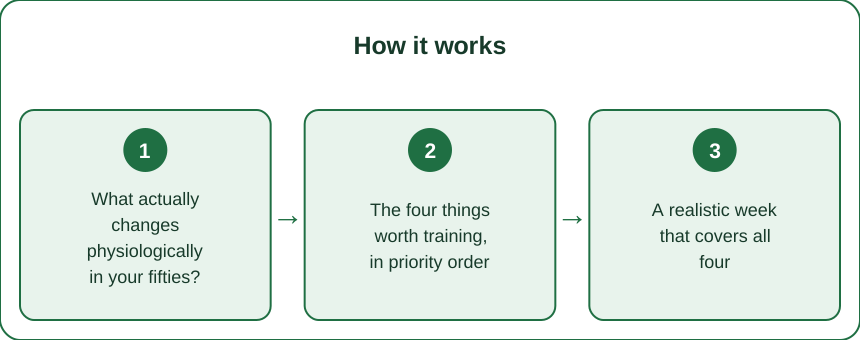
What actually changes physiologically in your fifties?
Several things, and they are not the ones the fitness industry emphasises.
Muscle mass loss accelerates. Sarcopenia - age-related muscle loss - begins in the thirties but the rate typically increases from around fifty onward. The commonly cited figure is roughly 3 to 8 percent per decade after 30, rising after 50 without resistance training. Crucially, this is not inevitable at that rate; it is largely a use-it-or-lose-it phenomenon, and trained people lose far less.
Bone density declines, sharply for women around menopause. Oestrogen is protective of bone, and the years around and after menopause see the fastest loss of a woman’s life - often the largest single change in this decade.
Recovery takes longer. Not dramatically, but noticeably. Connective tissue in particular adapts more slowly, which changes how fast you should progress rather than how hard you should train.
Balance and reaction time begin their slow decline - and this is the most under-trained area of all, because it does not feel urgent at fifty and is very hard to rebuild at seventy.
What does not change as much as people assume: your capacity to build strength. Research on resistance training in older adults consistently shows meaningful strength and muscle gains well into the seventies and eighties. The ceiling is lower than at twenty-five. The trajectory is entirely within your control, and that is the thing worth internalising at fifty.
The four things worth training, in priority order
1. Heavy resistance training - two to three sessions weekly.
This is the highest-value item and it is not close. Not light weights for high reps - loads heavy enough that the last two or three repetitions are genuinely difficult, typically in the 6 to 12 rep range.
- Compound movements: squat or leg press, deadlift or hip hinge, push (press or push-up), pull (row or pulldown)
- 3 sets each, 2 to 3 times weekly
- Progressive overload - the weight goes up over time, or it is maintenance rather than training
- 48 hours between sessions for the same muscle groups
2. Impact or loaded movement for bone.
Bone responds to load and to impact. Resistance training covers much of this, and adding some impact helps:
- Walking is insufficient stimulus for bone on its own, despite its many other benefits
- Brisk hill walking, stair climbing, hopping, or jumping where joints allow
- 20 to 40 impacts, a few times weekly, is a commonly used starting point
- Weighted vest walking is a reasonable option for those who cannot do impact
3. Balance and single-leg work.
Under-trained and disproportionately important, because falls are the mechanism by which many people lose independence.
- Single-leg stands, working toward 30 seconds each side, eyes open then closed
- Step-ups, single-leg deadlifts, lunges - loaded single-leg work trains strength and balance at once
- Five minutes, three times weekly is enough to make a difference
4. Cardiovascular training.
Genuinely important for heart health and it is the one most people already do. 150 minutes weekly of moderate activity, with some harder efforts if you enjoy them. The reason it is fourth is not that it matters least - it is that most people over-allocate to it and under-allocate to the first three.

A realistic week that covers all four
This assumes someone reasonably active but not currently strength training. Adjust down if you are starting from further back.
Monday - Full body strength (45 min)
- Goblet squat or leg press: 3 x 8
- Dumbbell row: 3 x 10
- Push-up or chest press: 3 x 8
- Single-leg balance: 3 x 30 sec each side
Tuesday - Cardio (30 to 40 min) Brisk walk with hills, cycle, or swim. Conversational pace.
Wednesday - Rest or gentle mobility
Thursday - Full body strength (45 min)
- Romanian deadlift: 3 x 8
- Overhead or incline press: 3 x 8
- Step-ups: 3 x 10 each leg
- Farmer’s carry: 3 x 30 metres
Friday - Cardio + impact (30 min) Walk or run, with 20 to 30 hops or stair intervals included.
Saturday - Something you enjoy Hiking, tennis, a class, gardening. Adherence over decades comes from enjoyment, not optimisation.
Sunday - Rest
How to progress: add weight before adding reps or sets. When 3 x 8 feels manageable with two reps left in reserve, increase the load by roughly 5 percent. Progress will be slower than it was twenty years ago and it will not stop.
Protein deserves a mention here because it is the nutritional lever with the clearest evidence in this decade. Older adults appear to need more protein per meal to trigger the same muscle-building response - commonly cited targets sit around 1.2 to 1.6g per kg of body weight daily, spread across meals rather than concentrated in one. Speak to a doctor or dietitian about your own situation, particularly if you have kidney concerns.
Myth vs Fact: Fitness at 50
Myth: You should switch to lighter weights and higher reps to protect your joints. Fact: this is the most commonly given and least useful advice in this decade. Heavy loading, with good technique and sensible progression, is what maintains muscle and bone. Light weights for high reps build endurance and do very little for either. Joint pain is a reason to change the exercise selection, not to abandon meaningful loads.
Myth: It is too late to build muscle after 50. Fact: studies in adults in their sixties, seventies, and eighties consistently show meaningful gains in strength and muscle mass from resistance training. Later is harder. It is not too late, and the gains from starting late are proportionally large.
Myth: Cardio is the priority for heart health as you age. Fact: cardio is important, and muscle mass and strength are also strongly associated with health outcomes and longevity. The mistake is treating them as alternatives. Most people over-allocate to cardio because it is familiar.
Myth: Menopause makes fitness gains impossible. Fact: it changes recovery, body composition, and sometimes motivation, and it makes strength and impact training more important rather than less. Many women reach their strongest in their fifties, often because it is the first decade they train seriously.
Myth: A milestone challenge is a good way to mark the birthday. Fact: a fifty-of-something challenge is fun and harmless if you are already conditioned. As a starting point after a sedentary stretch, a high-volume novel challenge is a reasonable way to acquire a tendon injury that stops you training for three months. Start the habit, not the event.
FAQ: Turning 50 and Training, Answered
I have not trained in years. Where do I actually start?
Two full-body sessions weekly with body weight or light dumbbells, focusing on technique for the first month, then adding load. Two months of consistency beats an ambitious first fortnight followed by nothing.
Do I need a trainer?
A handful of sessions to learn hinge and squat mechanics is money well spent, particularly if you are loading a deadlift for the first time. Ongoing supervision is optional.
What about joint pain during strength work?
Pain that is sharp, or that persists after the session, means changing the exercise rather than pushing through. There is nearly always a variation that loads the muscle without irritating the joint. Persistent pain deserves an assessment.
Is walking enough?
For cardiovascular health and general wellbeing, walking does a great deal. For muscle and bone, it is insufficient on its own. Walking plus two strength sessions is a substantially different proposition from walking alone.
Should I get a bone density scan?
Worth discussing with your doctor, particularly for women around or after menopause or anyone with risk factors such as family history, early menopause, or long-term steroid use. A baseline measurement makes later changes interpretable. This is general information, not medical advice - talk to a healthcare professional before starting a new programme.
TL;DR:
- Heavy resistance training two to three times weekly is the highest-value item, by a wide margin
- Add impact or loaded movement for bone, especially for women around menopause
- Five minutes of balance and single-leg work three times weekly protects independence later
- Cardio matters and is usually the thing people already do enough of
- Build the habit rather than doing a one-off milestone challenge from an untrained base
Fifty is an unusually good time to start, because the returns are large and the trajectory of the next twenty years is genuinely still open. Pick two days a week, load them properly, and let the birthday be the start date rather than the event.
Keep Reading
This article is for general informational and styling purposes only. Fit, sizing, and product availability may vary.